14 April 2026
History of Patrick Sarsfield
Read about the history of Patrick Sarsfield below.
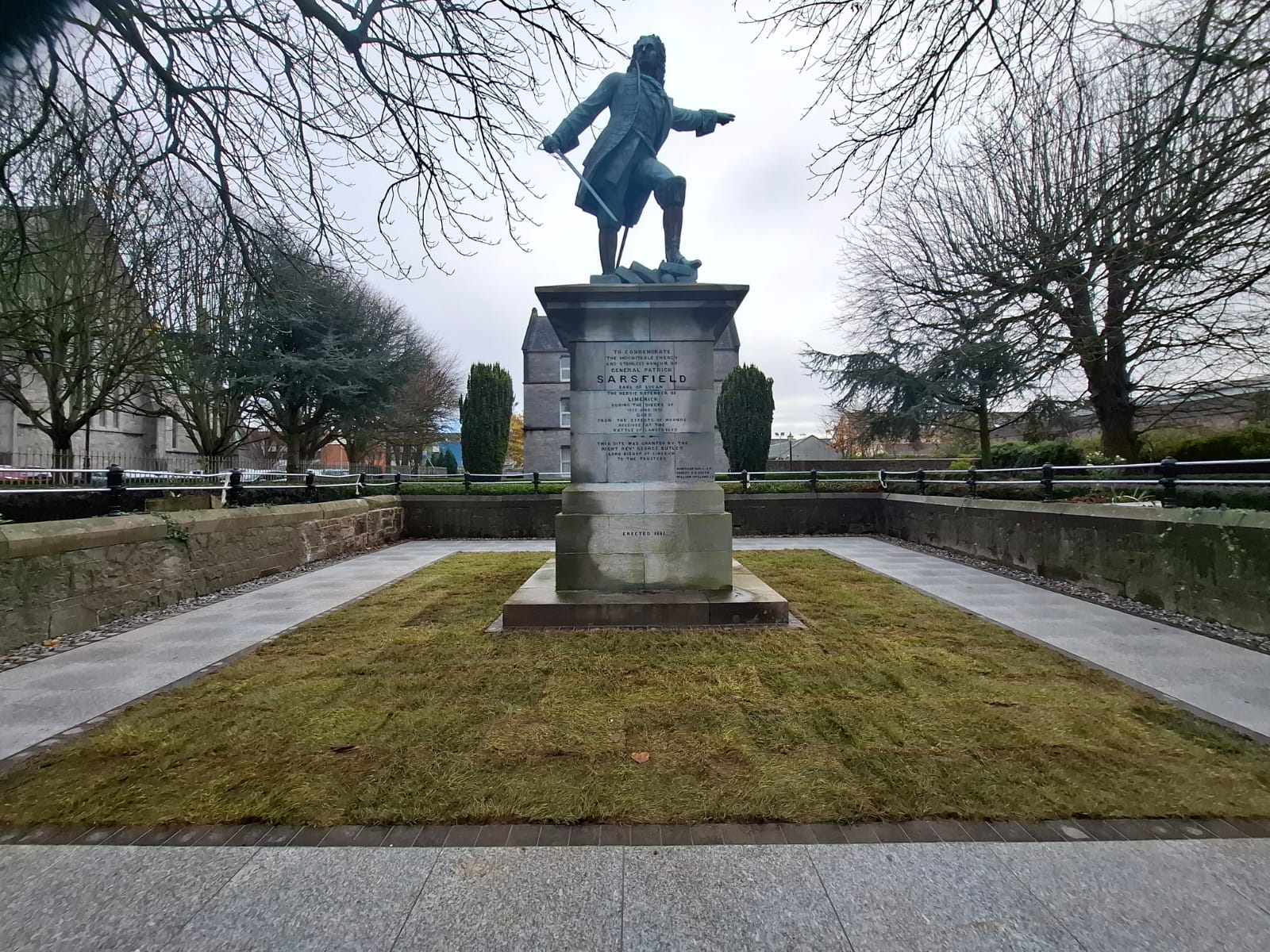
The story is told of a mythical meeting at the start of the 1900’s between the three pre-eminent statues in Limerick at that time. It is said that Daniel O’Connell commented that his location meant that he was at all times at risk of being demolished by traffic, Viscount Fitzgibbon, whose statue was on Sarsfield Bridge complained that the winds and weather blowing up the Shannon meant he was never warm, and Patrick Sarsfield complained that after all he had done for Limerick that his statue, by virtue of its location had been relegated to obscurity. 125 years later O’Connell now has a traffic island protecting him, Lord Clare had his chills removed on 9th June 1930 when a bomb blew up his statue, but it would be fair to say that Patrick Sarsfield could still point to the fact that his statue never got the prominence which befits the saviour of the city.
It wasn’t always meant to be this way, in fact, numerous sites were proposed and rejected for the Earl of Lucan’s statue. At one point it was to be placed where the monument to Limerick Pork Butchers now stands in the street island in Upper William Street, another proposal had it being placed outside the main gate of the People’s Park at the Junction of Mallow Street and Pery Square, another had it in Bank Place and Maurice Lenihan proposed that it not be placed in the city at all but at Ballyneety where O’Hogan and Sarsfield intercepted King William’s ammunition train and caused an explosion that was said to have “Lit the midnight Sky”. The truth is that were it not for the intervention of Bishop George Butler who granted the site at Cathedral Place in 1881, Sarsfield statue may never have found a “temporary” permanent home.
That site in 1881 was a very busy one, the spire of the Cathedral was inching its way
heavenward and many of those working on the project were living in encampments in the cathedral grounds. Some of the site now occupied by the Cathedral and Presbytery (which wasn’t built until 10 years after the statue was placed there) had been granted to the diocese by the Limerick Market Trustees and much of the area around the statue was inhabited by hundreds of people living in small houses in a warren of lanes that crisscrossed Gerald Griffin Street and Cathedral Place.
It had taken 36 years from the time that the project was first put forward in 1845 by the
Mayor William Geary, who himself was an alderman for the John Street Ward of Limerick
Corporation until it was finally erected in 1881. While this was undoubtedly a considerable timespan much had happened in the intervening time to distract the fundraising efforts. Indeed, many of the great characters of Irish history were involved in the efforts in including Thomas Davis and William Smith O’Brien who encouraged the fundraising committee to seek funds in the USA in the early 1860’s. Their efforts were thwarted by the American Civil War as the Irish efforts had been scuppered by the Great Famine and its aftermath. In fact, it is recorded that none other than the French government was to be canvassed. No money was received from the British government towards the project though the Corporation did make a small contribution.
By 1875, 30 years after the fundraising began the total fundraised was £560 and this was
supplemented by interest in that period to £700. At that time, it was hoped that the statue of Sarsfield would have him represented riding his horse into battle but when quotes were sought it was found that the cost of such a statue would have been over £2000 so after much discussion and argument it was decided that Limerick’s hero would have to “stand on his own two feet”.
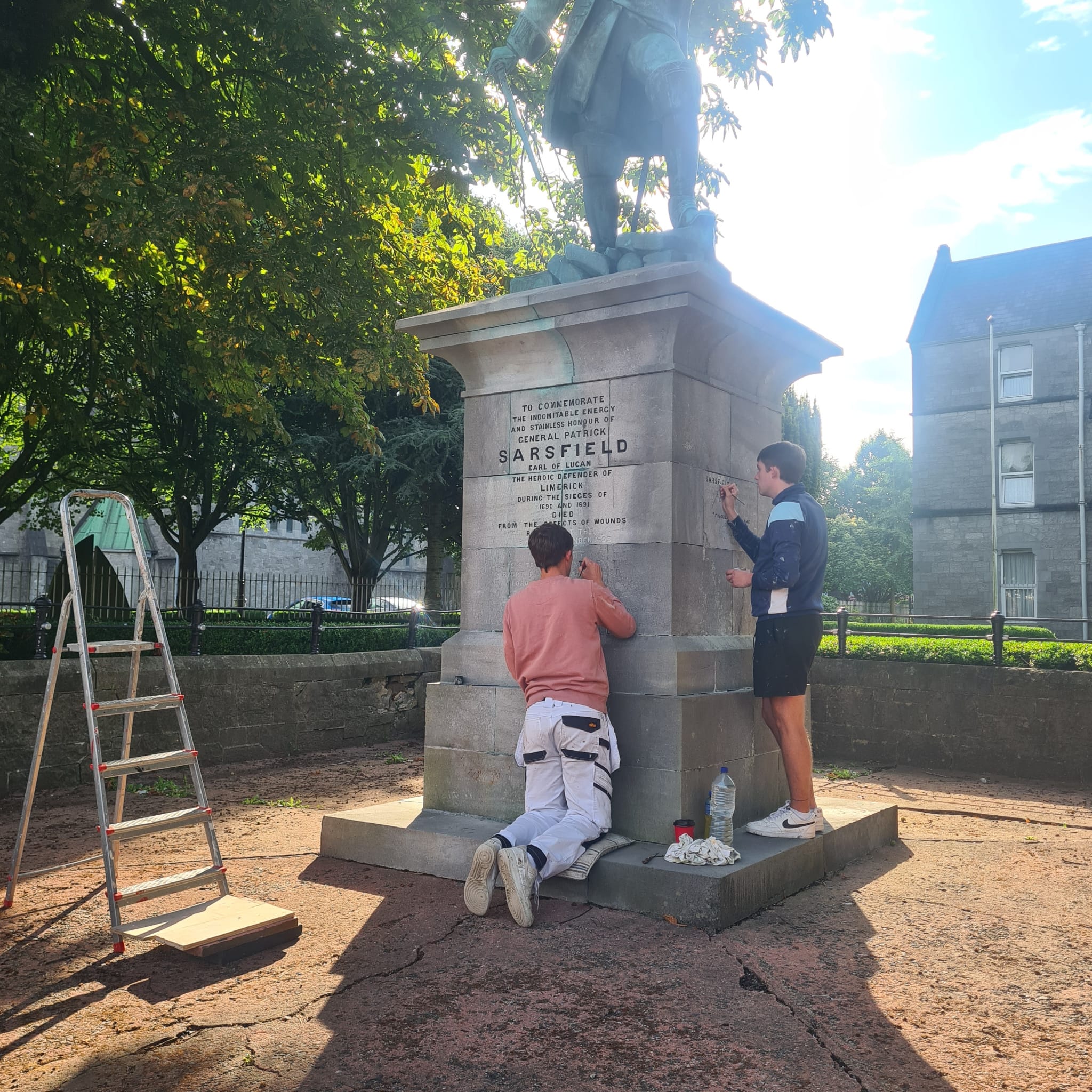
The statue was designed by John Lawlor (1820-1901) of Dublin and cast in Young’s London Art Foundry. The statue followed a sketch made by a local artist, Henry O’Shea. Lawlor was an accomplished sculptor who had worked on some of the sculptures in the Houses of Parliament in Westminster as well as some iconic works in Cobh Cathedral. Throughout this final push for completion of the statue a figure emerges that hasn’t seen recognition anywhere in the project and one who should be remembered for his doggedness. Thomas Baker Jones was the secretary to the Sarsfield Memorial Committee and was very much the “glue” that ensured that the project came to fruition. His family name is most associated with Baker Place in the Dominic Street area of the city where they were merchants and landowners.
The unseemly and often divisive debate about the placement of the statue only came to an end when, as a temporary solution, Bishop Butler offered the site at St John’s. The whole project seems to have been one of compromise, firstly in relation to the issue of Sarsfield’s horse and secondly about the site.
In truth were it not for the persistence of Baker Jones and Bishop Butler and Ambrose Hall as well as Robert O’Brien and William Spillane as trustees it is doubtful that the statue would ever have found a home as it remained in storage for a considerable period after it was cast. Ambrose Hall had been a strong driver of the project, and his view was that it should be in Bank Place. In fact, much of the difficulty with deciding on a placement had to do with personal animosities within the council to Hall but ultimately it was he who spoke with the bishop and obtained the site.
No official unveiling ceremony ever took place for this, one of Limericks most iconic pieces of sculpture, and this despite the words of Bishop Butler who reflected the Limerick sentiment towards Patrick Sarsfield when he said: “Every Irishman and especially every Limerick man is proud of Sarsfield, of his military genius, of his dashing bravery, of his stainless honour, of his deep, steadfast and undying love of Ireland. None of her sons has served her better, dared more for her at home, or won more honour for her name abroad”.